Showing posts with label Pacific-Northwest Native Plants. Show all posts

Monday, March 23, 2015

Stinging Nettles with Grits and an Egg

   So it's been a while, I guess.  I took a little hiatus.  I focused on my kids, survived the holidays, ate horribly and gained weight and lost weight and gained it back.  I went to Maine to see my brother marry the most wonderful woman on earth.  I learned that I really like candid photography.  Food photography is easier because usually the subject stays still for ya but candid photography is so much more rewarding when you get "the" shot.  

This was that shot:

chiaroscuro portrait photography

I swear I didn't pose her this way.  The light, you guys!  The light...  I can't even.  *Sigh*

     Anyway, I learned some stuff about myself in my time off.  I miss black and white photography, I like taking pictures of people, and apparently, I like to eat stinging nettle.  Who knew, right?


     Stinging nettle is crazy painful and also crazy good for you if you can get past the crazy painful part.  It's also delicious!  So somehow, I have gone my almost 40 years without ever seeing stinging nettle in the wild or getting stung by it.  But I found some at recent farmer's market and managed to sting the fool out of myself almost immediately.  Dag, ya'll.  Ow.

     So anyway, I decided I needed grits this morning and stinging nettle was going to go along with it.  So good.  I guess I was supposed to remove the leaves from the stems before cooking, but I couldn't find any specific directions about that online.  I just went ahead and cooked the stems, too.  It was fine.  No stings, good flavor, just a little too furry for my husband's taste.  I'll probably strip the leaves next time.

Stinging Nettle with an Egg and Creamy, Cheesy Grits

Stinging Nettles with Grits and an Egg
Serves 4

1 C grits
4 C water
Cheese

Butter
4 eggs
3 C stinging nettle very lightly packed
olive oil
salt and pepper

Cook grits to package directions, mine called for 1 C grits to be rinsed, then placed into 4 C boiling water and simmered for 30 minutes.  I add cheese to mine, I like sharp cheese like Beecher's Flagship, but I encourage you to find your favorite local cheddar.  Stir in a little butter and salt and pepper to your taste.  In the mean time, fry or poach four eggs.  I like mine over easy, but poached eggs would be fantastic on this.  Rinse the stinging nettle.  I used tongs to transfer mine to a salad spinner, rinsed in the basket and spun it around until dry.  Heat olive oil in a large pan, then dump nettles in.  Watch out for stingers!  If I were to cut the leaves off first, I would use gardening gloves to hold them while I removed the leaves after washing.  Heat leaves until just wilted and plate as shown.

Review:
     The boys weren't having the nettles.  They saw me get hurt and were NOT having any of that business.  My husband and I were a little trepidations, but the flavor was like a pleasantly strong spinach and pared well with the eggs and grits.  If you can't find nettles or are in the boat with my boys, sub out the nettle with spinach.

Monday, June 23, 2014

Flowers for Breakfast...

Marigold, Thimbleberry, Thyme, Salsify, Borage, Pea, Lavender, Dandelion, Nasturtium, Blackberry, Pak Choi

Flowers are an unusual and underused way to brighten and beautify your plate.  Seeing the sad, wilting, expensive box of organic flowers in my grocery store every week never inspired me to try edible flowers.  Last year, I grew some nasturtiums as a pest control measure in my garden and was surprised at how delicious they were!  One of my favorite early Summer drinks is lavender lemonade, so much so that I bought the lavender we have just so I can make it once a year.  This year, I bought some new veggies because I'm always trying new things and found I love borage and since my pak choi came up and went directly to seed, we have been eating the blossoms.  Last night, while inspecting my squash for potential blossoms, it occurred to me how many edibles I had blooming right now.  So here I am sharing them with you!  This is by no means an exhaustive list of all edible plants.  It's more like a snapshot of my garden in the middle of June.  If you are equally uninspired by your grocery store, may I suggest planting a flower garden?

Crackers on the Couch: Edible Flowers, Maridold


Marigolds have a bitter taste at first that mellows out into a floral aftertaste.

Uses: Salads, garnishes, jelly
Crackers on the Couch: Edible Flowers, Thyme Blossoms


Thyme: First taste is like a slightly sweet thyme, which is followed by a little herbal burn (similar to fresh oregano), finishes as a straight thyme flavor.

Uses: Salads, smoothies, soups, garnish for chicken

Crackers on the Couch: Edible Flowers, Salsify Flowers


Salsify: Slightly sweet petals, the stem starts out with a green flavor, becomes peppery and ultimately tastes very similar to thyme.

Facebook users may recognize this as my quiz plant from a few weeks ago. Nobody got it right!

Uses: Salads, salad dressings
Crackers on the Couch: Edible Flowers, Blackberry Flowers

Himalayan Blackberry petals are slightly bitter, the stamen are powdery and lacking flavor, but the blossoms are undeniably beautiful.

Uses: Salads, garnish
Crackers on the Couch: Edible Flowers, Pak Choi Blossoms


Pak Choi taste very much like how daffodils smell: floral, earthy, and fresh.  They have a slight kale or broccoli flavor, being in the same family.

Uses: Salads, smoothies
Crackers on the Couch: Edible Flowers, Blue Podded Pea blossomCrackers on the Couch: Edible Flowers, Little Marvel Pea Blossom


Garden Peas: The white flower is off a bush pea called Little Marvel and the purple one is off a climber called a Blue Podded Pea.  They taste like green peas, fresh out of the garden, pod and all.  The finish is very similar to alfalfa sprouts. 


*I was going to give a warning about Sweet Peas, the ornamental flower, since I had heard they were poisonous.  Mr. Internet says this is a bit of a misconception.  The only thing that isn't safe to eat in large quantities is the hardened seed of the Sweet Pea.  Still, if you want to be cautious, don't eat them.  More flowers for bees!


Uses: Salads, garnish
Crackers on the Couch: Edible Flowers, Spanish Lavender Blossoms


Spanish lavender has a strong, herbal, well basically, lavendery flavor. 

Uses: Lemonade, baking


Thimbleberry petals have a very slight floral citrus taste.

Uses: Salads, salad dressing, garnish


Borage: Once you get past the fur, you are rewarded with a strong cucumber flavor.

Uses: Salads, sandwiches, salad dressing


Nasturtium: Spicy, think horseradish without the burn, peppery, finishing with a slightly sweet taste.

Uses: Salad, garnish, salad dressing, pizza


Dandelion: The petals are really fabulously sweet, but the greens taste like earwax, so pluck these before adding them to anything.

Uses: Salads, wine, jelly, tea

Tips:
If you want to use flowers in your salad, I suggest picking them before you are ready to serve.  Many of these flowers wilt soon after picking.  Nasturtiums, marigolds, lavender, and borage will last the longest, but any Mom who's been given a dandelion bouquet knows how quickly those go south!

My spinach, pak choi, cilantro, and lettuce are bolting right now.  I've been using the flowers in smoothies every morning to try to extend the season a bit.  I'll be doing the same thing as soon as the purslane, and basil go.

Saturday, July 21, 2012

As Promised...

The latest offerings from the Cracker Garden:

 Sugar Ann Snap Peas, a favorite from last year, one of two heirloom varieties in our garden this year.

 That darling little blip is the fruit of Frageria vesca the woodland strawberry.  A native here and brand new to our garden this year.  I photographed it here next to a medium sized farmer's market berry so you could see the size difference.  Quite a spread!  The flavor is intense and wonderful, but as my husband said after eating two at once, "That's about an eighth of a mouthful!"  He's right, they're not going to fill you up, that's for sure.  But he suggested, and I agree, that it would be a great little thing to put on a salad.  I'm already dreaming up ideas for next year's crop since we ate this year's entire crop just testing them out...

Another native plant, Claytonia perfoliata aka miner's lettuce.  Likes part sun, moist conditions, and sandy soil.  Pretty much the exact conditions of my garden... Especially the shady wet part...  =) This is another new one for my garden.  It's quite a delicious little thing (each leaf being no bigger than a quarter) and it tastes a lot like spinach.  Having a time keeping the slugs off of it currently, so I'll have to consider that next year, but the few leaves we've gotten made nice additions to salads and sandwiches and I like to have a little sample every time I go into my garden!

Next up: Chives, Thyme, and Red Huckleberries!

Wednesday, December 21, 2011

12 Days Detox

12 Days of cookies was soooo fun!  Thank you all for your following along and leaving me such kind comments!  Whew!  That was a lot of sugar!  Yummy, yummy sugar....  But now it's time to eat something that doesn't make my eyes twitch or float in it's own butter boat.  I thought I'd use some winter vegetables and a throw a little Christmas in there with some chestnuts!

Chestnuts are wonderful in this, but you could substitute hazelnuts.  I'd actually love to get my hands on some chinkapins one day.  Their sweet flesh would be beautiful with the kale.  But there aren't any Christmas songs about chinkapins that I'm aware of...

(Chanterelle mushrooms, kale, shallot, parsnip, chestnuts)

Parsnips are lovely.  If you haven't tried them, they're a little like a carrot.  When they're cooked, they're like a cross between a carrot and a potato.  Fried in a pan, they develop a delicious caramelized crust around the edges and it's just heaven.

I used a combination of chanterelle and yellowfoot mushrooms both of which are at the very end of their season here.

These are yellowfoot.  Yellowfoots?  Yellowfeet...?   Whatever they are in plural form, my forager, David, said that they are related to chanterelles.  They both like living under evergreen trees.  You can really tell when you eat a raw chanterelle.  They're hot and peppery and taste like a pine tree.  Cooked, they mellow out into chewy, earthy bliss.  The yellowfoot have a slight anise flavor raw.  They are smaller, so they cook up much more quickly than the chanterelles.  Very soft, and very similar to a button mushroom in flavor except for the faint taste of anise.  Unlike the chanterelles, I could happily eat these raw.


Pan Fried Parsnips
6 chestnuts shelled and sliced
2 large parsnips
olive oil
6 oz chanterelle and/or yellowfoot mushrooms
1 large shallot
1 bunch of kale
salt and pepper

Shell out your chestnuts and peel off as much of the papery inner layer as you can.  Slice thinly and cook over medium low heat for 3-5 minutes or until the skin begins to flake off.  Remove from pan and remove as much paper as you can.

While the chestnuts are cooking, you'll have time to slice the parsnips to about 1/8-1/4 inch thickness.  Once the chestnuts are done, put about a tablespoon of olive oil in the warm pan and add the parsnips.  Fry on medium-high heat until they soften and begin to caramelize, around 10 minutes for thinner slices.

While the parsnips are cooking, you can peel and slice your shallot and roughly chop the mushrooms.  When parsnips are softened, add mushrooms and shallots.  Cook until the mushrooms and shallots begin to brown (about 10 minutes).

Remove the well cooked parsnips, mushrooms and shallots to a side plate.  If there are any parsnips that aren't thoroughly cooked, leave them in the pan.  Deglaze with a little water or maybe some white wine.  (I didn't have any on hand, but I was wishing I did...) Add kale and steam in the deglazing liquid for a few minutes.  If you like (and I like) you can let the fluid cook away and brown the kale a little.

Stir the parsnips, shallots, and mushrooms back into the kale, salt and pepper to taste, and serve topped with chestnuts. 

Review:
The first time I made this, I only made about half.  Mr. Crackers and I were both really disappointed there wasn't more!  Serve this with rice if you like, I think tonight I'm going to try it with wild rice.  Other things you might try in this are apple, garlic and fresh herbs like thyme or rosemary. 

PS, Do you like that platter?  It's an early Christmas present.  I'm in love...

Monday, October 3, 2011

A Bit More on Berries

In the spirit of Unprocessed October, I thought I'd go ahead and post the rest of those native berries I mentioned a while ago. What can be less processed than berries you walked outside and picked yourself?

Sambucus caerulea

These are elderberries.  I had never seen these until last week when my forager, David, brought some to the farmer's market.  They are interesting tiny little berries, they have a fairly large seed compared to the flesh around them, so they're a little crunchy, but they taste great.  David suggested drying them and then using them as you would blueberries in pancakes or muffins or on top of oatmeal.  I used these fresh and made them into cough syrup for my son who's come down with a cold.  =( 


These are snowberries:

(Symphoricarpos albus)
 
 They might be my favorite native berry, even though they're inedible.  They are just so beautiful clinging to the bare branches in the wintertime.  My bushes don't produce as prolifically as ones that get more sun.  (And are less covered in English ivy...)  *ahem...*

 
Vaccinium ovatum

These are evergreen huckleberries.  I bought these last Spring and haven't gotten around to planting them yet (eek!) so I don't really know much about these berries.  I assumed they'd be a little larger than this, and probably would have been if I hadn't been such a bad Mommy...

This is a Himalayan blackberry bush...

Rubus armeniacus

If you get a bunch of good berries, this is what happens:


If you get one sour berry, this is what happens:


These will also make you pull that face. 

 
Mahonia nervosa

These are low Oregon grapes.  They are sour as all get out, though the underlying flavor is pleasant in my opinion.  You know, if you can get past the gut clenching sour part...  There is a very similar looking plant called tall Oregon grape, the berries are more oblong, but rest assured they are still sour enough to suck off the insides of your mouth.

 
Gaultheria shallon

And these little darlings are salal berries.  They usually grow right next to the Oregon grape and wouldn't you know it?  They're sweet, a little like a blueberry.  I've heard people make jelly out of them and use the Oregon grape as the pectin, though mine barely produce, so I don't have that luxury...  These pictured here are a little smaller than the norm partly because it's so late in the season, and partly because they get very little sun which is great for the plant, but not so great for the berry production.

 Vaccinium deliciosum

And finally, another native huckleberry, the Cascade huckleberry or Cascade bilberry.  These berries are larger and sweeter than most other huckleberries.  Usually around the size of small blueberries.  David hooked me up with some of these this year, too.  They're great in oatmeal with a little chia and molasses!  The Latin name says it all!

I've said it before and I'll say it again, don't eat anything unless you know for sure what it is.   That said, I hope I have encouraged you to find out what edible natives grow in your area and to search them out.  From prickly pears in California, to blackberries in Washington, to teaberries in North Carolina, to dandelions on lawns everywhere, you may be surprised what you can find to nosh on!

Thursday, July 28, 2011

Unsolicited Education...

In my Huckleberry Jam post, I mentioned a few other Pacific Northwest native berries in my yard that have begun to ripen, so I thought I'd share a little about them, too.  No recipe with this one, just pictures of berries.  Why?  Meh.  I just find it interesting. =)

This is the native Trailing Blackberry, Rubus ursinus.  When I first moved here, I wanted to be sure I was protecting the native plants when I weeded my garden but didn't know the first thing about how to tell the difference between the native and non-native blackberries.  Now I know the native berry hugs the ground on tiny, fairy like vines and produces beautiful, superior tasting, if less prolific, berries whereas the non-native Himalayan Blackberry (Rubus armeniacus) forms giant troll-thickets that will eat you alive and taunt your Happy Fun Ball.  There is nothing subtle about the Himalayan bush.  The berries come on the trailing blackberry first, as you can see, mine are already nearly done, while my Himalayans are still in bloom.  I find the flavor of the native berries far superior, more concentrated and "blackberry" tasting. The Himalayans are much larger, but always let me down in the flavor department.  They are great for cooking with because they are just so darn prolific, so I like to eat the natives plain and save the big boys for adulteration with sugar and pie crust.

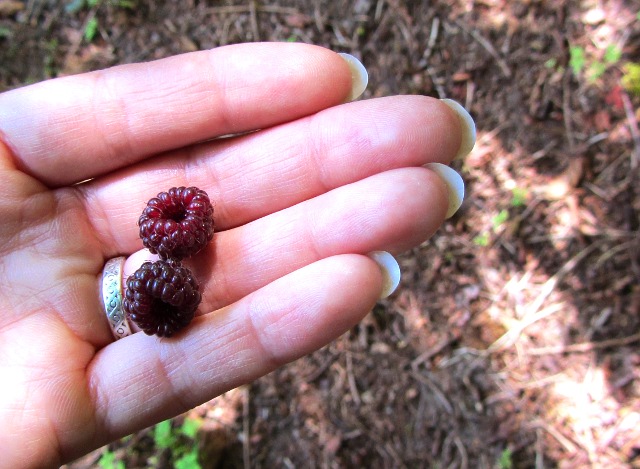
Now, on to another black berry but this one is the native black raspberry, Rubus leucodermis.  Again, I was afraid at first that I might confuse this plant with those darn Himalayans, but even though this plant is upright, the canes are much thinner than the Himalayan and also have a slightly powdery looking stem in the Spring.  These berries are a very dark red when completely ripe and will fall off in your hand when ready to be eaten.  These have a very light raspberry flavor, but it is still delicious.  Mine don't produce as prolifically as the Himalayans, but then, what does?

Here is an unripe berry.

 And this is what they look like when green.

 
And here's what they look like right before I toss them into my mouth!  Nom!

This little lovely is an unripe thimbleberry, Rubus parviflorus.  They might well be one of my favorite native plants.  I can't get over the huge, maple-like leaves and the sweet flowers.  I love how the unripe berries are nearly white before turning bright red.  (PS, see that malicious-looking, light green, spike-covered cane to the left of those berries?  That's a new, 1st year cane of a Himalayan blackberry.  They get easily twice that big.  Nasty boogers.)

This one is about a day away from being truly ripe.  They are very delicate.  When you pick them, it's all you can do not to have them crumble in your fingers.  They're called "thimbleberry" because the opening in the top is so big you can easily put your finger in it!  Flavor-wise they are very interesting.  When you put them in your mouth, the first thing you'll notice is how furry they are.  It's a little like peach fuzz in texture.  And then the little thing will just disintegrate into a small, sweet, vaguely raspberry flavored, whisper and be gone.  There's no use trying to use these in any recipe as the plants aren't prolific at all (maybe as many as 10 or 15 berries per bush if you're lucky) and they're so darn fragile you'll never get one home intact, but they are fun to forage!

The evilly attractive flower of the accursed Himalayan blackberry.  (hiss, boo...)  She's Delilah, I tell you.  Lures you in with her promises of pie and jam and then sneaks into your room at night and cuts your hair.  When you wake up, she'll have eaten half your garden and climbed up your trees and the only way to get rid of her is to drop a house on her.
And finally, just because I went on and on about how pretty the plant was in my previous post, here is the foliage of the red huckleberry.  I just love how the little berries hide underneath the leaves like a peek-a-boo game.  Peek-a-boo!  I eat you!  BWAHAHAHAHAAAA!  Uh... *ahem...*  yeah...

As always, if you're not positive what a berry is, don't eat it.  Still, these are all a fairly safe bet since they are so distinctive.

Later on in the year, I'll have some Low Oregon grapes producing, some Salal berries, and hopefully some Evergreen Huckleberries, too.  Very late in the year, I will hopefully have another of my favorite berries, the (inedible) Snowberry.  I'll post pictures of them when they're ripe, too.  Why?  I just find it interesting!

Wednesday, July 13, 2011

A Tale of Two Jams...


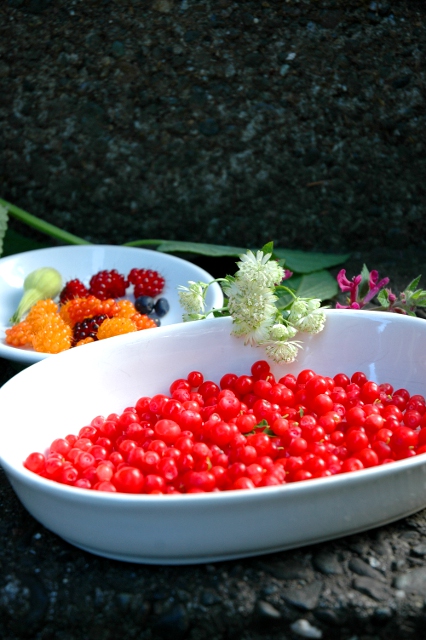
We've been foraging in the woods for wild berries lately.  A couple of days ago, we found salmon berries (in 2 colors), Indian plums, and lots and lots of red huckleberries.  That green thing is a native beaked hazelnut.  They are edible, and presumably very good, but nobody's ever eaten one in the history of the State because the squirrels just go crazy over them!  I picked this one so the boys could see what the pod looked like.


Hazelnut and two different colors (both ripe) of salmon berry.

Salmon berries, despite their orange color, taste a lot like tart, loose blackberries.  You won't find these in any store because when they're ripe they just fall apart in your hand.  There's no transporting these babies!  They are great for jams too, or just eating as fast as you can, snuffling like a foraging bear in the woods, like we do at this house.  Pick them as you would a blackberry.  It needs to practically fall off in your hand.  If it gives any resistance at all, it's not ready.

Indian plums (the blueberry looking fruit in the first picture) have large seeds and taste not unlike a cucumber.  It's an interesting taste experience and if you were starving, I suppose they'd do, but I can't say I'd put these on my every day list.  But it's definitely worth a try just to say you had one.  Only the female trees produce fruit (which doesn't have anything to do with anything, but us ladies gotta stick together...).  Pick the fruit when it's pretty soft, and easy to pull off the tree, otherwise they're bitter and downright awful. 

We're eagerly awaiting the native blackberries, thimble berries, and raspberries that are forming as we speak, to be followed at the end of Summer by the invasive, yet so terribly tasty Himalayan blackberries that spread like prickly, brambly wildfire here in the Pacific Northwest.  If nothing untoward happens, it looks like we're in for a great haul of those bad boys this year.

We are fortunate that our property is dotted with a plethora of wild red huckleberry bushes.  Red huckleberries are one of the very few wild red berries that are safe for human consumption.  *DISCLAIMER!!* Do not eat wild berries (espeically red ones) if you don't know exactly what the are! *END DISCLAIMER!!*  The boys love them because they're so pretty and easy to pick.  No thorns, berries at kid level, tart, crisp little balls of yum that burst in your mouth.  As a plant, they are one of my favorites, too.  They are beautiful in the Winter with green stems that sport little pink buds as Spring arrives.  Darling little mouse-ear leaves cover it for a while before pink berries about the size of a lentil arrive in the early Summer. 


I debated for a while what to do with these little yummies.  Raw, with a dollop of ice cream was a big contender for a while, but I figured since this is a cooking blog, I couldn't very well let these little guys go without being cooked.  So I settled on jam.  This is an old-fashioned jam recipe.  No pectin needed.  Just berries, sugar, and water.  I burned the first batch.  Beyond all reason and recognition.  I was sad.  But if it weren't for that, I wouldn't have gone berry picking this morning.  Early dawn.  Just me, the slugs, a few annoyed birds, and the bleary-eyed dog walkers (you know who you are) all joined together greeting the day in one of the most beautiful places on Earth.

 A little photo tutorial for those who've never made jam before.

Pick some berries. (Pay no attention to the ghostly pale arm floating in mid-air.)

Pull off any stems and clean out any leaves or dirt.

Admire your work.  Preeeeeetty...

Wash the berries.

Weigh out your berries and your sugar.

Stir up berries and sugar.  Doesn't it look like Christmas?
Then add water and turn on the heat.

Bring it to a rolling boil.  Keep an eye on it once it reaches this stage.  It's liable to boil over on you at a moment's notice.

Skim off the scum. (PS, it's called scum because it doesn't look pretty in the jars, it's not dirty.  You can totally eat it while you're waiting for your jam to cook if you want!  Watch out, it's hot!)

Check for gel.  Use a cold plate, place a dollop of jam onto it.  If it forms a gel in a few seconds and not a soup, you've got jam, baby!  (Take the rest of your jam off the heat while you're checking for gel.  If it's ready, you don't want to burn it while the test sets up!  It should take less than 30 seconds...)

And then, before you know it, you've got jam!


Easy-Peasy Red Huckleberry Jam
Equal parts berries and sugar
2 Tbs water for every 5 oz of berries

Boil the berries, sugar, and water until it reaches the gel stage, stirring very frequently.  Be sure not to over-cook it which will cause scorching and make it taste like a mixture of popcorn and fruit as Mr. CotC kindly suggested while trying to soothe me as I was bemoaning the fate of my first batch... =)  Oh, and then it'll turn into rock hard popcorn and fruit flavored candy, not exactly what you want to spread on your toast in the am...

I boiled mine for 20 minutes.  Yours might cook faster or slower depending on how much you have.  I had 5 oz of berries.

To preserve:
Sanitize your jam jar.  I filled mine with boiling water, but you can also use your dishwasher or the old "boiling the jar in a pot of water" trick.  If you plan to save your jam for a while instead of eating it right away (really though, why would you?) make sure your jam comes close to the top of the jar.  It is safe to use a water bath canning method on jams.  Boil the submerged jar in a covered pot with a rack on the bottom for 10 minutes.  This is assuming you don't have a huge batch of jam.  If you somehow manage to collect enough berries to make a huge batch, good for you!!  You obviously managed to keep the bear snuffling to a minimum!  For more information on water bath canning, visit the Virginia Cooperative Extension site here

A little butter, a little jam... bliss...

Review:
The slight tang makes this jam a little like cranberry sauce.  It's much sweeter, though.  Maybe a little like ligonberry jam, if you've ever tried that.  It's definitely worth the time you'll spend on it.  Though, raw on ice cream is a really safe bet, too!
Related Posts Plugin for WordPress, Blogger...